Arabic-only voice acting is not automatically a dealbreaker, especially for a game whose world and aesthetics are rooted in Arabic culture. If Arabic-speaking players are already a core audience, that is a valid position on its own, and players coming from outside that audience may already expect the original language to be part of the experience.
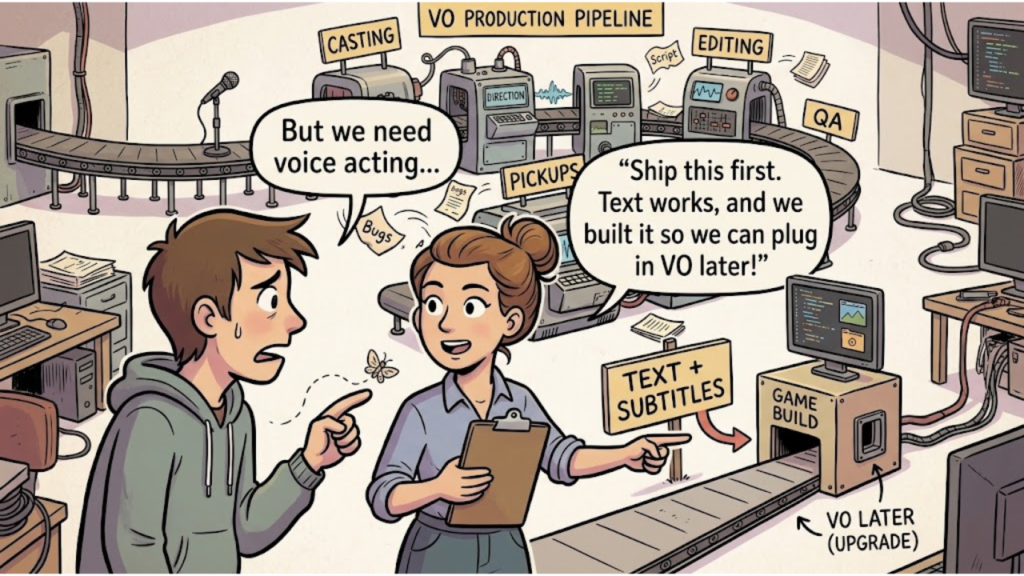
The bigger decision is whether subtitles make the game accessible enough and whether the production is structured so additional dubs can be added later if the audience justifies the cost.
Start with audience, not language count
A culturally specific game does not need to behave like a product designed for every possible audience on day one. If the game already has strong appeal to Arabic-speaking players, success with that audience is meaningful on its own. If Arabic is part of the game’s identity, removing that specificity just to feel more “international” can weaken the thing that makes the project distinct.
That does not mean ignoring players outside the core audience. It means separating audience access from voice production. Good subtitles, readable UI and localized text can open the game to more players without requiring a full additional dub immediately.
This is where game audio as player experience becomes useful as a framing. Voice is part of the player’s relationship with the world, not a checkbox that automatically improves because more languages were recorded.
Subtitles can carry a lot of the localization work
For a small production, subtitles are often the most practical way to support players who do not speak the recorded language. They cost less than a new dub and they let the original performances remain consistent with the cultural direction of the game.
The important part is treating subtitles as a real system. They need stable text references, readable presentation and a localization workflow that can be updated as the script changes. In Unreal Engine, Epic’s current localization tools support culture-specific text targets and iterative gather, export, import and compile workflows, which is useful when translations need to evolve during production.
A subtitle system that is planned early is much easier to extend than one added after the dialogue logic is already tied to hard-coded strings or audio filenames.
A second dub is a production commitment
Adding another voice language is not just a casting decision. It creates another recording pipeline that has to follow the same script changes, pickups, implementation and QA as the original language.
That cost keeps appearing after the first recording session. A line changes late, a cinematic timing shifts, a subtitle needs to stay synchronized, or a pickup is required in one language and not another. The more languages you record, the more coordination the dialogue pipeline needs.
This is why a small team should avoid treating full multilingual VO as the default. The additional dub should solve a real audience or commercial problem, not just reduce anxiety about how the game might be perceived outside its primary market.
Keep the dialogue system ready for expansion
You can ship one voice language without locking the project into one voice language forever. The architecture matters more than the number of languages you record at the beginning.
Keep dialogue references language-independent, separate subtitles from audio assets, and avoid gameplay logic that depends on a specific filename. In Unreal Engine, localized Dialogue Wave workflows can associate spoken text, subtitle overrides and culture-specific audio without requiring the conversation logic itself to be rebuilt for every language.
That does not mean you need to adopt every localization feature in the engine. The principle is simpler: the game should request a line or dialogue state, and the localization layer should decide which text and audio belong to the active language.
Do not build future scale into current scope
Future-proofing does not mean recording languages you cannot afford yet. It means avoiding decisions that make future expansion unnecessarily expensive.
A solo developer can keep the first release focused and still prepare the project for later growth. If the game finds an audience in another market, you can then decide whether translated subtitles are enough or whether a localized dub has enough value to justify the production work.
That is also where production discipline matters. Audio bottlenecks often come from dependencies and ownership, and dialogue is no different. A clean localization structure now reduces the amount of rework later.
Let the product answer the next localization question
There is no useful universal rule that says a culturally specific game needs English VO to reach players outside its original language. The better decision comes from the audience you actually attract, the feedback you receive and the commercial priorities of the project.
If players are comfortable with localized subtitles, keep the original VO. If a specific market becomes strategically important and players are clearly asking for a dub, then you have a concrete reason to invest.
That sequence protects both the identity of the game and the budget. You are not localizing every possible layer in advance. You are keeping the system ready so the project can respond when the audience gives you a reason to expand.
A practical default for small teams
For a small team building a culturally specific game, a sensible starting point is one strong voice language, well-localized subtitles and a dialogue system that can support additional languages later. That keeps the first production scope realistic without treating localization as an afterthought.
Arabic voice acting can be part of the game’s identity. The production mistake is not choosing one language. The mistake is building the project so adding another one later requires rebuilding the dialogue pipeline.