If you are a small Unity team without a dedicated audio designer, you probably do not need FMOD yet if your native setup already keeps gameplay code separate from AudioClips and your adaptive-audio needs are limited.
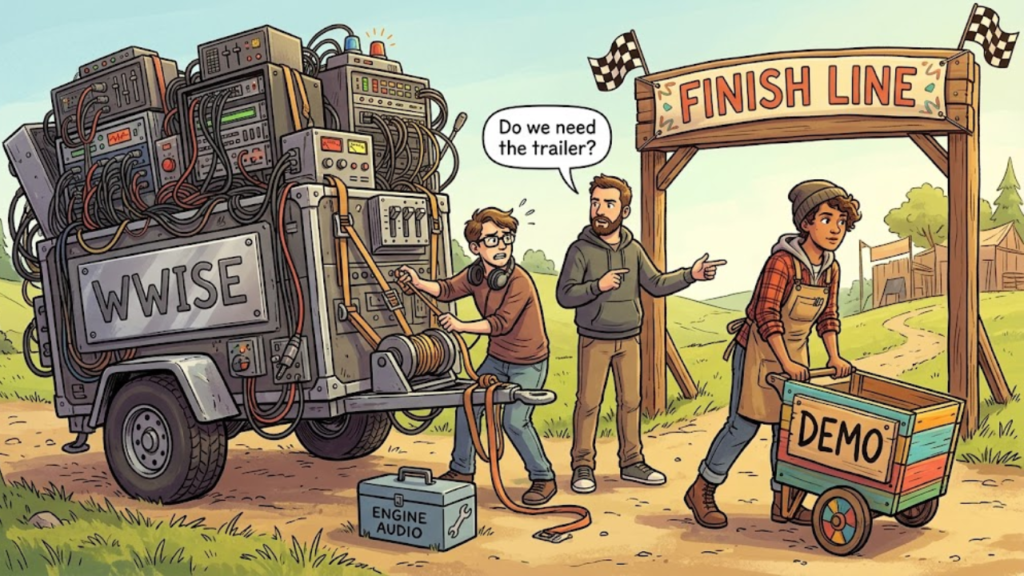
FMOD can add a lot of useful infrastructure, but it also adds another shared project, integration and workflow for the team to own. In our own work we use FMOD on some projects, Wwise on others, and sometimes stay with the engine’s native audio system, so middleware is not the default answer. The better question is whether it solves a problem your current Unity audio system is already struggling with.
Middleware is not automatically the mature choice
FMOD provides a dedicated authoring environment and integration for adaptive game audio. Routing, snapshots, parameters, mixing, randomization, transitions and profiling give an experienced audio team a lot of building blocks without recreating them inside Unity. Its current Unity documentation covers installing the plug-in, connecting FMOD Studio content and driving audio from the game.
It is less valuable when the team mainly needs straightforward playback and nobody owns the middleware project. A mature tool decision is not the one with the longest feature list. It is the smallest system that supports the production well.
For a first game, unnecessary infrastructure can become another place to maintain versions, content and responsibilities.
Your native abstraction already matters
A ScriptableObject-based layer that maps gameplay requests to audio assets is doing useful work. Gameplay code no longer needs to know which exact clip will play, so content can change without rewriting the system that triggers it.
That separation is one of the useful principles in a scalable setup. It keeps asset decisions out of gameplay code and gives the team a cleaner place to add audio behavior later.
Before replacing the system, identify what is actually missing.
There is also a useful historical connection here: Unity staff historically described the built-in audio system as using FMOD as its low-level engine, while FMOD Studio is a separate middleware authoring system. That does not make the two workflows equivalent, but it is one reason some core audio concepts can feel familiar when moving between them.
Build the next layer around runtime behavior
The next useful step is often centralizing how AudioSources are created and controlled. Unity’s native AudioSource component already provides clip playback, 2D/3D spatial behavior and mixer routing, so a small team can build a practical runtime layer without leaving the engine.
Pooling or a lightweight audio manager can reduce scattered setup and make routine playback rules easier to maintain. The goal is not to build a custom middleware package. It is to keep the native system predictable as the project grows.
If that setup continues to solve the game’s problems, there is no reason to replace it just because FMOD exists.
FMOD changes the collaboration model
FMOD becomes another shared production project. If several people are editing it, everyone needs Studio installed and ideally on the exact same version, and the team needs to be clear about who owns integration updates and bank builds.
Source control also needs discipline. In our experience, Perforce tends to make this kind of shared workflow easier, while Git requires more care around who is editing what and who is responsible for building and updating banks. For an experienced audio team that is normal production work; for a small group where everyone contributes occasional sounds, it can be more process than the current scope needs.
This is why tool choice should follow ownership. Flexibility only helps when someone is responsible for the system.
Add FMOD when the native system starts fighting you
The strongest reason to introduce middleware is that the audio requirements are becoming awkward or expensive to maintain natively. More dynamic mixing, parameter-driven behavior or a dedicated audio workflow can create that point.
FMOD’s parameter system, for example, lets game code drive event and mixer behavior from runtime values, which is exactly the kind of infrastructure that becomes valuable once audio is reacting to more game state.
At that stage, adoption has a clear purpose. You can compare the cost of extending the native system with the cost of introducing middleware.
Keep future-proofing proportional
A first game does not need an audio architecture designed for every feature the team might eventually add. Future-proofing becomes counterproductive when it creates work before the game needs the capability.
Keep the native system clean, decoupled and documented. Leave room for middleware later, but wait until it solves a real constraint.
Why I Use Audio Middleware in Game Development goes deeper into what middleware buys a production once those needs are real. For a small Unity team with limited adaptive-audio requirements, a strong native foundation can still be enough.