If you are a solo developer with zero budget for voice actors or professional translation, the practical answer is to scope full VO out of the first version unless it is essential to the game. Text and subtitles are a completely valid release strategy, and the money and time will usually be needed elsewhere.
The important part is not pretending voice and localization will never exist. Build the dialogue system cleanly enough that recorded VO and additional languages can be added later without rebuilding the narrative logic.
Full VO is a scope decision
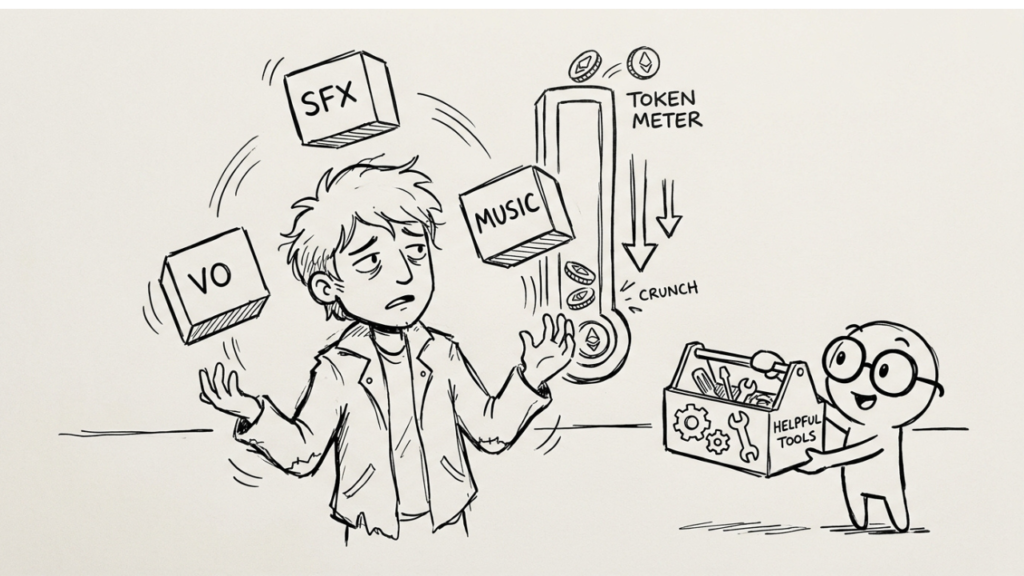
A zero-budget project has limited production capacity even when one person is doing everything. Time spent recording, editing and fixing dialogue implementation is time not spent on gameplay, art, bugs or release work.
Actors are only one part of the workload. Recorded dialogue also brings script lock, casting, direction, file naming, editing, integration, pickups, localization dependencies and QA. Even a few hundred lines can become a real production pipeline, so if the game works with text, unfinished VO is rarely a better trade than finishing the game.
The decision gets easier when you stop treating VO as a binary feature. You are not choosing between “fully voiced” and “unfinished.” You are deciding how much production complexity the game can support right now.
Text is a valid production choice
Text keeps iteration cheap while the project is still moving. A line can change without another recording session, another audio file or another pass checking whether the performance still fits the scene.
That flexibility matters before the script is stable. If narrative changes every week, early VO turns normal writing revisions into pickups and file management. Text-first can protect the project while the writing, pacing and quest logic are still finding their final shape.
Scope translation the same way
If the budget is zero, do not promise languages you cannot review properly. Start with the languages you can support with confidence, then expand when the audience or release plan gives you a reason.
Machine translation and language models can help with placeholders, layout tests or internal estimates. For release text, someone still needs to judge meaning, tone and context. The quality bar matters more than the number of language options in the menu.
This is especially important for tutorials, objectives and narrative lines where a small translation mistake can become a player-facing usability problem rather than just awkward prose.
Use AI voice as a prototype tool
We usually use synthetic voices to prototype systems, test timing and validate player progression before the script is locked. They let you hear the dialogue system working without turning every revision into a recording task.
In our experience, the acting quality is still noticeably lower than a strong final performance, so AI voice should not become the default answer just because it is cheap. The useful question is whether that compromise matches the look, feel and quality bar of the game. This is the same production lens we use when evaluating AI in game audio.
If the voice is only there to prove that a tutorial sequence, bark system or conversation flow works, a temporary solution can be enough. Keep the prototype clearly replaceable so it does not quietly become the final asset by inertia.
Selective VO can be enough
If completely text-only dialogue feels wrong, reduce the voice scope instead of forcing the whole script through production. Important cinematics, tutorial moments or short reactions can carry a lot of identity without creating a full VO pipeline.
Choose a clear category and keep it consistent. A small controlled batch also teaches you how much recording, editing, integration and testing actually cost inside your project before you commit further.
Build the dialogue system for later
The expensive mistake is not launching without voice. It is building dialogue as if voice or localization will never exist.
Keep stable line IDs, separate displayed text from audio files, and let gameplay reference dialogue entries rather than specific filenames. Current Unreal Engine localization documentation follows the same general separation between localizable text, culture-specific assets and dialogue audio, although the exact implementation will vary by engine.
This structure keeps future VO and localization from becoming a rewrite. It also avoids the kind of dependency problem that turns audio into a late production bottleneck, which is covered in more detail in Why Audio Becomes a Bottleneck in Game Development.
Add production layers when the game earns them
Professional VO makes more sense when the project has a reason to support it: funding, a stronger market signal or a design where performance has become central to the experience. By then the script is usually more stable and you have better information about how much dialogue actually needs to be recorded.
Translation should follow the same logic. Add languages because the audience and release plan justify them, then budget for a quality level you can actually review. That keeps scope tied to the product instead of to a feature list.
A practical zero-budget default
For a solo developer with no budget, I would keep the first version text-first, build solid subtitles and keep the dialogue architecture ready for VO and localization later. If voice is essential to the identity, use it selectively.
Use AI or scratch voice to prototype when it helps. Do not let a cheap placeholder quietly become the final quality standard. The first job is finishing a coherent game.