The cost usually appears later: rework, unclear gameplay feedback, implementation debt, milestone pressure and a final build that never had enough time to sound coherent.
Skipping professional game audio can look like a budget decision early in development. The team uses temporary assets, keeps implementation inside engineering and plans to “polish audio later” once the core game is working.
The problem is that audio depends on the same systems the rest of the game depends on. Animation, UI, gameplay states, narrative, cinematics and performance all affect what the audio team can build. When audio enters too late, the production often loses the time needed to test those relationships properly.
That is where the real cost appears.
Late Audio Creates Rework
A late audio pass usually inherits decisions that were made without considering sound.
Animations may have no clean sync points. Gameplay states may not expose the data the audio system needs. UI events may be inconsistent. Cinematics may already be locked. Music may have been commissioned without a plan for transitions or stems.
Now the audio team has two options: work around the existing structure or ask other departments to reopen finished work.
Both cost time.
Game Developer’s article on preparing audio for an alpha launch makes this production risk very clear. It argues that audio systems need to be present early enough to test implementation, identify missing functionality and iterate before milestones harden around incomplete assumptions. The article is useful because it treats audio readiness as a development problem rather than a final polish task.
Placeholder Audio Can Hide Design Problems
Temporary assets are useful during development, but they can create false confidence when nobody tests whether the final system actually communicates the mechanic.
A placeholder gunshot may tell the team that the event fires. It does not tell them whether the weapon has enough variation, whether distance is readable, whether the mix supports combat or whether the animation and sound feel synchronized.
The same applies to UI, footsteps, rewards and music. Placeholder audio proves that something can play. It does not prove that the final audio design works.
If the real design questions only appear near the end, the team has less room to solve them.
Poor Audio Can Reduce Gameplay Readability
The cost of weak audio is not only aesthetic.
Players use sound to understand space, timing, danger, confirmation and state. A missing cue can make an action feel unresponsive. A weak enemy sound can reduce threat readability. Poorly mixed UI can make feedback ambiguous. Inconsistent footsteps can make movement feel disconnected from the environment.
Game Developer’s “Creating Audio That Matters” focuses on this relationship between sound, mechanics and player understanding. The article shows how audio can communicate gameplay information and shape how players interpret the world.
When those signals are missing, the game may still function technically while feeling less clear, less responsive and less convincing.
Engineering Can Become the Hidden Audio Department
One of the most expensive versions of “we will handle audio internally” happens when programming quietly absorbs the technical work.
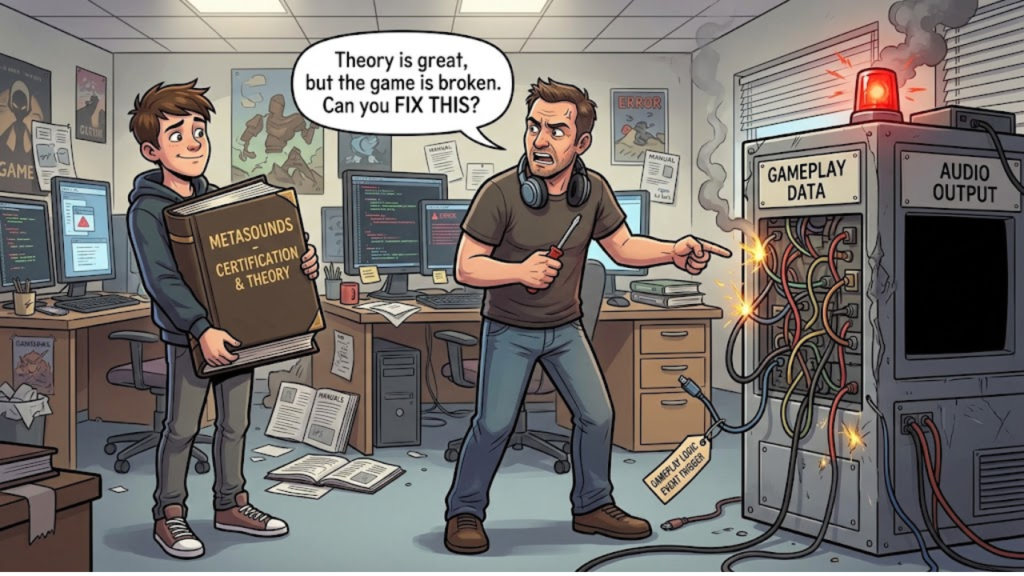
A sound designer or composer delivers assets. Engineering creates the triggers, exposes parameters, fixes middleware issues and handles runtime problems. Every revision now depends on someone whose main responsibility is not audio.
That creates a queue.
The audio team waits for engineering. Engineering loses time from gameplay or systems work. Producers coordinate the handoff. Small audio changes become multi-department tasks.
The cost is real even when it never appears on the audio budget.
Missing Direction Creates Duplicate Work
When there is no clear audio owner, teams often solve the same creative question several times.
One person defines the UI palette. Another commissions music with a different reference. A third person selects library assets for combat. Later, someone realizes the game has no coherent sonic identity and the production starts replacing work that was technically complete.
This is not a quality problem first. It is a direction problem.
Professional audio direction creates shared rules before the asset count becomes large. That does not eliminate iteration, but it prevents every system from inventing its own version of the game.
Milestones Become More Expensive Under Pressure
Late audio usually means compressed audio.
The team may need to finish large volumes of SFX, music, VO and implementation close to alpha, beta or content lock. Review cycles get shorter. Dependencies arrive late. Technical problems compete with creative work.
That is where crunch conditions appear easily.
The production is no longer deciding what the best audio solution is. It is deciding what can still be finished before the milestone.
Early audio work protects decision quality. The team has enough time to prototype, reject weak approaches, test systems in the build and scale only after the direction is proven.
VO Becomes Especially Risky When Left Late
Voice production has several dependencies that are difficult to compress safely.
Scripts need to be stable enough to record. Casting takes time. Recording sessions need scheduling. Editing and naming need consistency. Localization can multiply the asset count. Implementation and QA still happen afterward.
If script changes continue after recording, the project can quickly accumulate pickups and duplicated work.
Late VO also creates downstream pressure because the final files may arrive while cinematics, subtitles and localization are already trying to lock.
The cost is not only studio time. It is production coordination across several disciplines.
Music Can Be Finished and Still Not Be Production-Ready
A composed track can sound excellent and still create technical problems.
The game may need loops, stems, alternate intensity, transition points or stingers that were never planned. If those requirements appear after final composition and mix, the music may need to be reopened.
That is one reason professional game music needs implementation context early.
The score is not only a set of tracks. It is part of a runtime system, and the production should know what behavior is required before final delivery.
QA Gets More Expensive When Audio Arrives Late
Audio bugs are often contextual.
The wrong event fires after a state change. A sound disappears under voice limiting. A parameter fails on one platform. A mix snapshot masks important feedback. A cinematic transition clips. A localized line uses the wrong file.
These issues become visible only after the content is implemented and tested.
If implementation happens late, QA happens later.
Now bug fixing competes with release pressure instead of normal iteration.
A professional pipeline builds validation into production rather than treating it as a final check.
Professional Audio Does Not Mean Outsource Everything
The solution is not that every studio needs a large external audio department.
Professional audio can be internal, external or hybrid.
The important part is that the work has clear ownership, enough technical competence and enough time to iterate in the build.
A small internal team with strong direction can be excellent. An external team can add capacity or specialist support when workload changes. A hybrid model can keep creative ownership inside while moving production peaks outside.
The structure matters less than whether the responsibilities are actually covered.
Crafting Exceptional Game Audio looks at collaboration and production from another angle, while How Does It Work Hiring an Audio Team for a Game? focuses on bringing additional audio capacity into a project.
The Cost Is Usually Opportunity Cost
When audio is under-resourced, somebody else carries the consequences.
Engineering implements systems it should not need to own. Producers chase missing assets. Designers compensate for unclear feedback. The team reopens animations or UI. Players receive weaker information. The final production has less time to develop a coherent identity.
That is why “we saved money on audio” can be misleading.
The cost may simply have moved somewhere else.
A Practical Risk Checklist
Before deciding that professional audio can wait, ask whether the project already has clear audio direction, implementation ownership, stable review processes and enough technical capacity to test sound inside the build. Also check which other departments are currently absorbing audio tasks that would normally belong to a specialist.
If several of those answers are unclear, the project is already paying for audio. It is just paying through time, rework and production friction instead of an explicit audio budget.
Next Step
If audio is still mostly placeholders, make a short list of systems that depend on sound before the next major milestone. Then identify what needs creative direction, what needs implementation and what needs actual in-game validation.
Explore Flutu’s work or send us the current production stage if you want to identify where professional audio support would remove the most risk before the project gets closer to lock.