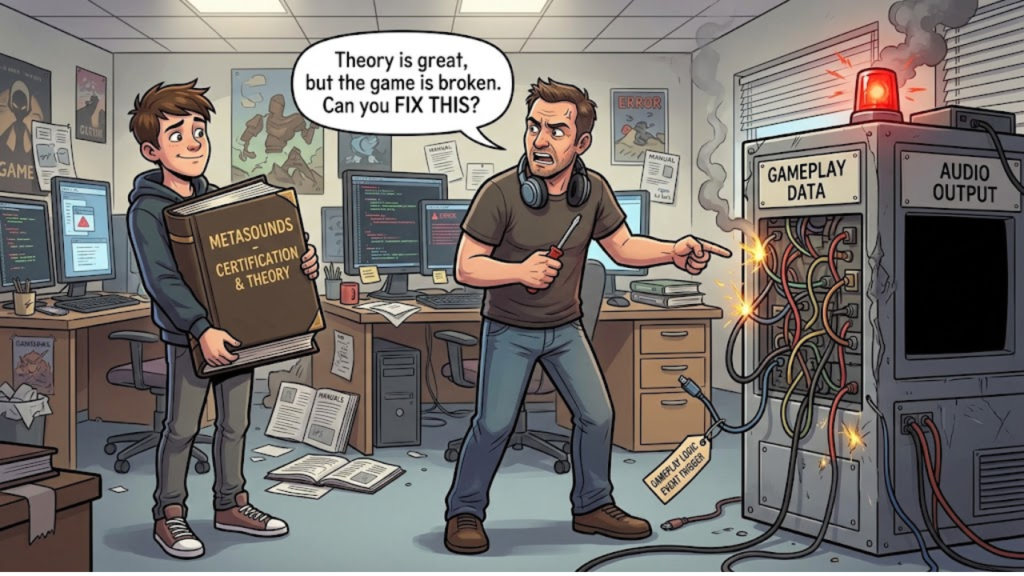
A great composer can write great music and still need someone inside the game production to translate between composition, design, implementation, schedule and the final build.
Bringing a well-known composer into a game can be exciting. The difficult part is not usually the composition itself. It is connecting the score to a production where the player controls timing, the game has changing states and the music needs to survive implementation, iteration and technical constraints.
That is where an Audio Lead becomes useful.
The role is not to stand between the composer and the creative team. It is to make sure both sides are solving the same game problem.
Film and Game Music Follow Different Timing Rules
A film composer works against a fixed timeline.
Game music often cannot.
The player may remain in exploration for ten minutes, trigger combat early, fail repeatedly or move between states faster than the score expects.
Berklee’s overview of interactive scoring describes techniques such as looping, horizontal re-sequencing, vertical remixing and stingers that help music adapt to real-time gameplay. Those techniques create production requirements beyond traditional linear scoring.
Someone needs to translate those requirements into a brief the composer can actually use.
The Audio Lead Defines the Music System
Before the final score is delivered, the team needs answers.
Which gameplay states affect the music? Do we need stems? Where can transitions happen? Does the music wait for bar boundaries? What happens when the player dies? Which cues loop? Which moments need silence?
An Audio Lead can work with design and engineering to define that system before the composer writes around assumptions that later turn out to be wrong.
This saves rework on both sides.
Composition and Implementation Need One Plan
Game Developer’s guide to designing with music in mind argues that music systems work better when music is considered during game design rather than attached after the mechanics are already locked. The article is useful because it frames adaptive music as collaboration between design, composition and implementation.
The Audio Lead sits inside that intersection.
They understand what the composer needs and what the engine can actually support.
That makes the score more practical without forcing the composer to become the project’s technical audio specialist.
Export Specs Are Creative Infrastructure
A soundtrack may need more than stereo WAV files.
Stems, alternate mixes, loop-safe versions, transition segments, stingers and naming conventions all affect implementation.
Those requirements should exist before final mix.
If the composer only discovers them after delivery, the team may need to reopen sessions, rebalance stems or rebuild cue structures that were never designed to be separated.
The Audio Lead protects the production by defining those deliverables early.
The Role Also Protects the Composer
Without a clear audio owner, a composer can receive contradictory feedback from producers, narrative, design and marketing.
The Audio Lead can consolidate that input into one musical direction and protect the composer from solving internal disagreement through endless revisions.
That creates a cleaner creative relationship.
The composer gets useful context instead of a collection of disconnected opinions.
Technical Profiling Still Matters
Interactive music can be expensive.
Several stems may play simultaneously. Transitions can increase voice count. Effects, streaming and memory use may change across platforms.
The Audio Lead should understand enough technical audio to work with middleware and engineering on profiling, debugging and platform constraints.
They do not need to personally write every line of integration code.
They do need to know when the music system is creating a production problem.
The Audio Lead Owns Continuity Across the Project
A composer may only be responsible for music.
The game also contains SFX, VO, UI and ambience.
Someone needs to understand how the score sits among those systems.
Does music leave room for dialogue? Do combat cues compete with weapons? Does the UI use musical stingers that should share the same harmonic language? Does a cinematic transition cleanly back into gameplay?
The Audio Lead protects the full audio picture.
That is where direction becomes larger than composition.
Famous Composers Are Not the Only Case
The role is useful even with composers who already know games well.
The issue is scale.
As the production grows, someone needs to manage deadlines, dependencies, reviews and implementation decisions across the soundtrack.
A composer should not need to attend every technical meeting to understand why a transition parameter changed.
The Audio Lead filters the production into the information the composer actually needs.
Music Should Be Reviewed in the Build
A cue can sound excellent outside the game and still fail once the player controls pacing.
The Audio Lead can help move reviews from playlists into gameplay earlier.
That means testing loops, transitions, music-to-VO balance and whether the score still works after repeated deaths or long exploration sessions.
The build tells you whether the system works.
The DAW only tells you whether the cue works.
Early Involvement Reduces Late Compromise
Why You Should Start Thinking About Game Audio Early expands the broader production argument.
For music specifically, early direction gives the composer enough room to design the score around the game rather than repair compatibility at the end.
That is usually cheaper and creatively stronger.
References Need Translation Too
Temp tracks can be useful, but they can also make teams over-attached to another soundtrack.
An Audio Lead can identify what the reference is actually communicating and convert that into language about tempo, instrumentation, emotional role and gameplay function.
Game Music Temp Tracks: How to Use References Without Copying Them explores that risk in more detail.
The Role Is Ultimately About Ownership
The Audio Lead gives the soundtrack one production owner.
Someone knows the creative direction, the technical system, the schedule and the dependencies.
That makes decisions faster because the project does not need to rediscover the same context every time music intersects another department.
For an example of thematic development inside a custom score, see How Composers Keep Players Engaged.
Next Step
If a composer is joining your project, define who owns the music system before the first delivery. That person should understand both the creative brief and the implementation constraints.
Explore Flutu’s music and audio-direction work or send us the production structure if you want to build a clearer bridge between composition and game development.