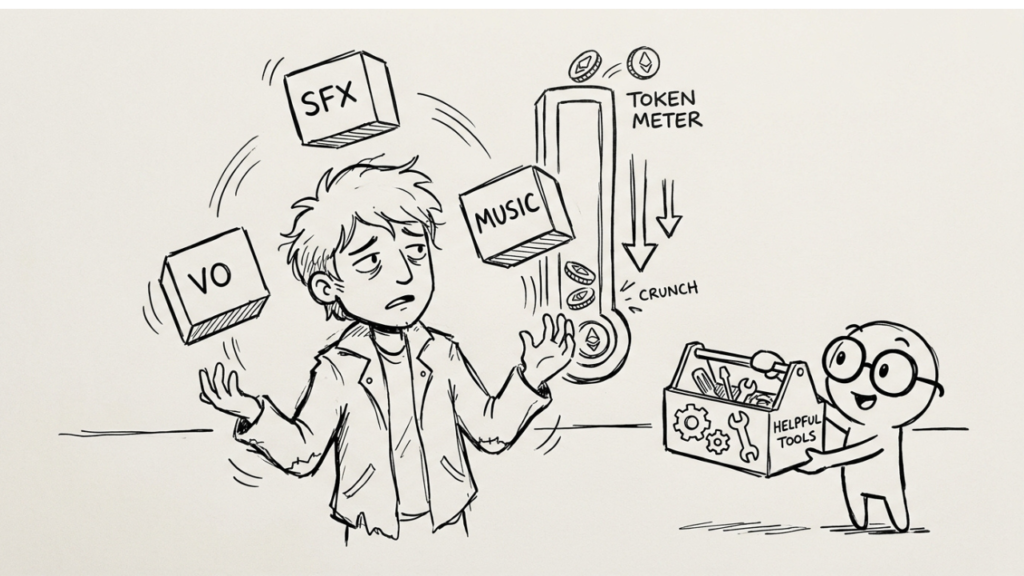
Great SFX design combines craft, listening, implementation and judgment. The asset matters, but the ability to make that asset work inside a real production matters more.
It is easy to evaluate sound design by listening to a reel. The harder question is whether the designer can understand a mechanic, translate feedback, build enough variation, implement the work correctly and keep the result coherent after the game changes.
That is why excellence in game SFX is larger than technical polish. The strongest designers connect creative decisions to gameplay, collaborate well with other disciplines and know when a sound is finished because it works in the game, not because it sounds impressive in isolation.
Listening Comes Before Designing
A good brief rarely arrives with every answer.
The designer needs to understand what the game is trying to communicate, which references matter, what the player should feel and which production constraints cannot be ignored. That requires listening before opening a DAW.
The useful questions are often simple. What does this event mean? How frequently does it happen? What else is playing at the same time? Does the sound need to communicate distance, success, danger or identity?
The designer who understands the problem usually makes better choices with fewer revisions.
Spotting Is a Design Skill
One sign of experience is knowing what deserves sound and what does not.
A game can contain hundreds of animations and thousands of events, but giving every movement a sound can make the experience noisy and expensive. Good spotting identifies which events actually carry player information, emotion or identity.
That judgment protects the mix and the production. Fewer unnecessary events means less implementation and QA, while important moments receive more attention.
A strong designer does not only create sounds well. They prioritize well.
Source Selection Should Support the Game
Game Developer’s sound-design primer describes recording, libraries and synthesis as common source methods. The article is useful because it treats sound creation as a process rather than a fixed technique.
A great designer can work with all three when needed. The important part is choosing source material that supports the game’s identity and production constraints.
A library sound may be perfect as a layer. A custom recording may be necessary for a signature mechanic. Synthesis may be the cleanest route for something that does not exist physically.
The method should serve the result.
Editing Needs a Clear Function
Layering more sounds does not automatically improve the asset.
Each layer should contribute something: transient, body, texture, movement, scale, material or tail. If several layers solve the same problem, the design becomes dense without becoming clearer.
This is where technical craft and restraint meet. EQ, pitch, dynamics, transient shaping and spatial processing are useful because they help control perception.
The goal is not to show how much processing happened. The goal is to make the event communicate faster and more clearly.
Repetition Is a Quality Test
Games repeat actions constantly.
A sound that feels excellent once can become irritating after twenty repetitions. Great SFX design anticipates that problem before the player discovers it.
Variation can come from alternate sources, controlled pitch changes, different layers, randomization or state-driven behavior. The system should preserve identity while preventing the player from hearing the same exact sample over and over.
This is especially important for footsteps, weapons, UI and impacts. High-frequency events expose weak design quickly.
Implementation Is Part of the Craft
A designer who understands implementation can make better creative decisions because they know how the sound will behave at runtime.
That includes triggers, states, parameters, attenuation, priorities, voice limits and routing. FMOD, Wwise, Unreal and Unity are part of the design environment because they determine how the asset responds to the game.
An event can sound perfect in the DAW and fail once it is triggered rapidly, heard at distance or layered with several other systems.
Great SFX designers review the behavior, not just the file.
Mix Awareness Separates Good Assets From Good Game Audio
A sound can be beautiful and still be useless if it disappears in context.
Game Developer’s “Creating Audio That Matters” is relevant here because it focuses on the effect sound has on gameplay and player interpretation rather than judging audio as isolated craft. The article gives several examples of audio serving information, space and emotional response.
Strong designers know when to simplify, shorten or reshape a sound so the important information survives the mix.
They also know when the right solution is to make another system quieter.
Feedback Should Improve the Work, Not Defend the Ego
A professional designer can explain a decision and still change it when the game needs something else.
That balance matters. Blindly accepting every comment creates inconsistent work, but defending every version as a personal statement makes collaboration impossible.
The better approach is to translate feedback into the problem behind the comment. “Make it bigger” might actually mean the impact disappears under music. “Less annoying” might mean the event repeats too often.
Good feedback conversations are about function.
Technical Range Matters, but Judgment Matters More
It is tempting to judge designers by difficult categories: weapons, creatures, vehicles or sci-fi systems. Those skills matter, but there is no single sound that proves someone is excellent.
A UI click can reveal just as much judgment as a huge explosion because the designer still needs to understand repetition, hierarchy, timing and fit.
The stronger indicator is whether the designer can adapt the approach to the production.
Different games need different solutions.
Documentation and Organization Are Creative Tools Too
Naming, versioning and source organization are not glamorous, but they directly affect iteration.
A team that cannot find the source session or identify which version is implemented loses time every time something changes.
Professional SFX work should be reproducible enough that another designer can understand what happened. That becomes especially important in larger teams and long productions.
The cleaner the structure, the easier it is to scale.
Great Designers Notice Problems Outside the Asset
Experience also shows up in what the designer notices around the task.
The animation timing is wrong. The gameplay event is firing twice. The mix bus is clipping. The requested asset does not solve the mechanic. The project is missing a state that audio needs.
Calling out those issues early can save more production time than polishing the sound another two hours.
That is part of being useful inside a development team.
Excellence Is Measured in the Build
The final test is not whether the sound impresses another sound designer.
It is whether the player understands the game better, feels the intended impact and stops noticing the production machinery behind it.
Game Audio Collaboration: How Better Review Produces Better Sound Design goes deeper into review and collaborative production. Sound Effects for Casual Games shows how the same principles change when repetition becomes the dominant problem.
Next Step
If you are evaluating a sound designer, ask for one project example where the first idea failed and what changed after implementation. The answer usually reveals more than another polished reel.
Explore Flutu’s sound-design work or send us the gameplay context if you want to discuss SFX design as part of the full production pipeline.